Language Selection


Interview: Why is it healthy to exercise in nature?
Due to a few mice at waterfalls, university lecturer Dr. Arnulf Hartl, head of the Institute for Ecomedicine at the Paracelsus Medical Privat University in Salzburg, explores the effects of exercise in nature. His results until now: Hiking and exercise, respectively, in nature have positive effects on your body. In an interview, he tells us about the different effects on different parts of the body, under which circumstances you should definitely exercise in nature and why descending a mountain is especially good for your body.
You examine the effects of hiking. Why do you do this?
This is a really interesting story: About 10 years ago, I worked as a researcher for vaccines and got the mission to examine the effects of the waterfalls Krimmler Wasserfälle on the health. I accepted the mission, eventhough I wasn't really interessted in that topic. So I stood in front of the waterfalls with numerous mice absolutely did not believe that the waterfalls have any effects on allergies or asthma. However, 800 mice later, I was convinced that there is an effect. And so we exposed 450 asthmatic kids to the waterfalls and the effects were the same as they were seen with the mice. The allergic asthma was gone for about four months - this was the period of time we examined it. After these results, I was full of medical curiosity and enthusiasm. And since then, we continously examined the effects of nature. This is how the Institute of Ecomedicine has been established. Now we examine chronic diseases such as back pain, osteoporoses, burnout, allergies and asthma and which effects exercise and movement in nature have on the body. Until now, we have never been disappointed. Hiking and exercise, respectively, definitely have positive effects on our bodies.

What happens in your body while hiking?
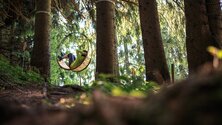
The lungs get wider, the heart pumps the blood quicker and there is generally more air in our bodies. That's the reason why neural activities are stimulated. There is proof that after exercise or movement, our concentration is much better. Our brain stays active as long as we move. That is the psychomotoric axis. As soon as a human being stops to exercise or to move, it slowly approaches death. What's most fascinating for me, is that nature increases this effect. The key word is "green exercise". Training in nature has more positive effects on your body than training in a gym.
What's the difference between a mountain hike and a hike along a flat trail?
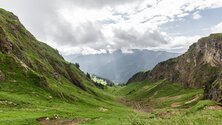
The training of the muscles is different. When descending, you get hits on your bones and your cartilages - this leads to a growth in tissue. The more impact, the more growth of tissue. Furthermore, even other muscles are required. Concerning the knee, desceding a mountain is a really wunderful and healthy method. This means that descending - contrary to what everyone thinks - is really good for your body. Moreover, the quality of the air in the mountains is especially high. Observing the map of fine dust, the Alpine region and the foothills of the Alps can be described as the green lungs in the middle of a sea of fine dust. And fine dust really is a killer. Only one percent more fine dust means a 10% higher mortality in the population. In the Alpine region and the foothills of the Alps there is an air quality, which can never be found in big cities.


Are there differences between hiking in unspoiled nature and nature which was changed by humans?
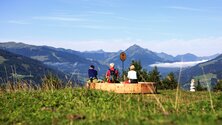
This is the question of reseach at the moment. Science has not come really far, concerning this topic. That's the reason why we are currently working on a study, together with the Institute for Sportspsychology at the University of Innsbruck, which specifically evaluates the effects of nature changed by humans and unspoiled nature on human bodies. We want to see, if there's a difference between unspoiled nature and artificial nature. If saving nature was a medical reason, it would have a much higher status, than it has now.
Hiking would be the best couple therapy, because a hiking holiday has positive effects on the relationship, even 240 days after it is over.
The psychatrist and psychotherapist Reinhard Haller once said: "If there was a pill that caused the same effects as going on a hike three times a week, this would be the most sucessfull medication in the whole world." What's your opinion on that?
This could definitely be true, however, I would change the word hiking into exercise or movement in general. If someone likes to play tennis to lose weight or to go mountain biking, they should do which ever sport they like the best. But you have to say that hiking in nature is a unique experience. It is the most natural and the oldest form of exercise. However, I would not say that other sports are not a good idea as well. The most important thing is to keep going. The happiness which you feel when exercising has a great impact on compliance and adherence.
To go hiking under health insurance cover - What do you think about it?
This is only possible when undergoing a course of treatment, which means only patients who already suffer from pain and are on rehabilitation. I think exercises should also be prescribed before someone even suffers from any kind of pain, but this method does not exist yet. Hiking would be the best couple therapy, because a hiking holiday has positive effects on the relationship, even 240 days after it is over. There are so many possibilities and you shouldn't forget that you can even hike to lakes in your region, which make a really good recovery area.
Pictures: Florian Lechner, Mattia Bonavida, Sportalpen, Daniel Meissner