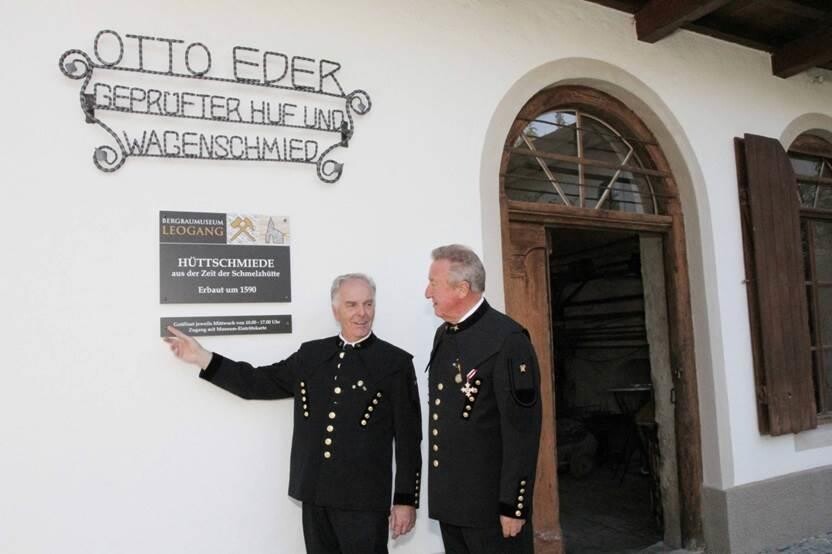
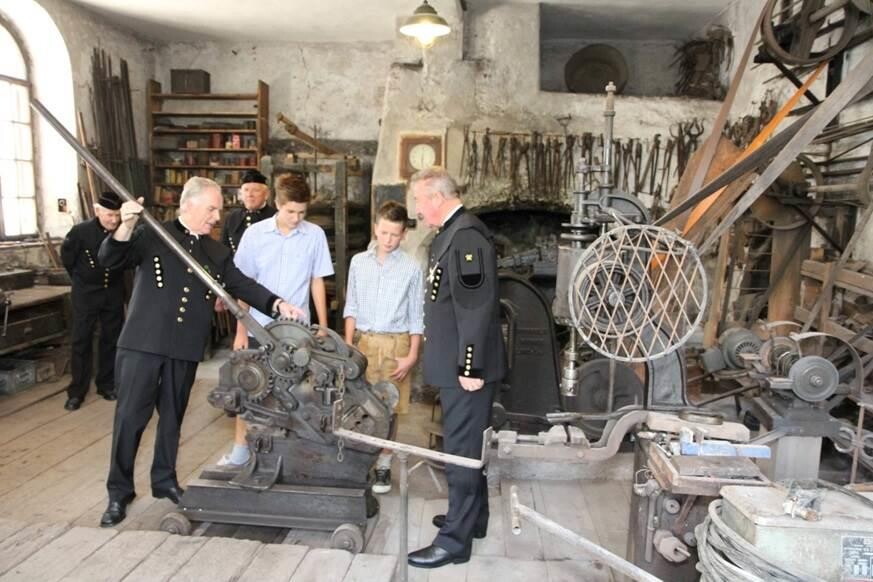
The thriving mining industry in the Schwarzleotal valley, the agriculture and forestry that already existed in the Leoganger Tal valley at that time, and the “little iron road” between Pinzgau and neighboring Tyrol were the sources of work for the blacksmith's workshop. The craft of the farrier, toolmaker, and wagon maker was in demand as a comprehensive activity. For centuries, the machines were powered exclusively by water from the Leoganger Ache (Fig. 1) using several water wheels. It was not until the last century that the switch was made to a single water wheel with transmission (Fig. 2) and finally, in the 1950s, to the introduction of electrical energy. At the forge, which still dates back to the Wilhelminian period with its classic Gothic arch, the iron was heated until red-hot and thus malleable (Fig. 3) and then further processed by hand on the anvil or by mechanical force on the heavy spring hammer (Fig. 4). A drill and natural grindstone (Fig. 5) complemented the machine tools. The forge operated commercially in its current form until 1972 and was later used occasionally for minor repairs. Since 2012, it has been open every Wednesday from May to October and during major events from 10 a.m. to 5 p.m. This allows visitors to experience the craft of working with red-hot iron up close.